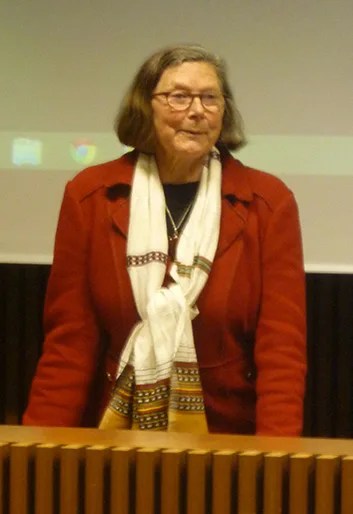
Christiane Floyd
A pioneer of user-oriented software development and the first woman to become a computer science professor in the German-speaking world.
Christiane Floyd is a pioneer of software engineering, participatory design, and user-oriented approaches to computing. She is also widely recognized as the first woman to become a professor of computer science in the German-speaking world.
Her story fits this project particularly well because it shows that computing has never been only about code. Floyd’s work emphasizes the relationship between software, people, workplaces, communication, and social reality.
Early path
Floyd entered computing when the field was still forming its academic identity. Her path included international experience and work in contexts where software development was becoming more formalized as a discipline.
As a woman in early computer science, she moved through spaces where female professors and researchers were still exceptional. Her career therefore represents both a technical contribution and an institutional milestone.
Rethinking software development
Floyd’s work helped challenge the idea that software can be designed successfully without understanding the people who use it. She became associated with user-oriented software development, evolutionary prototyping, and participatory approaches.
This matters for a project about stereotypes because it shows that IT is not only abstract logic. Software systems shape people’s work and lives, so designing them requires listening, collaboration, and reflection.
Barriers and institutional change
Being the first woman in a role often means carrying a double burden: doing the work itself and being treated as an exception. Floyd’s career shows how representation can slowly change institutions, especially when technical work is connected with teaching, mentoring, and new ways of thinking.
Her statement that computer science must change “from within” captures a core idea of this project: inclusion is not only about inviting more people into unchanged systems. The systems themselves also need to become more open, reflective, and human-centered.
What readers should take away
Christiane Floyd’s story shows that software engineering can be deeply social. Good technology is not created only by writing correct code; it is created by understanding context, involving users, and questioning assumptions.
For students, her path is a reminder that communication, design, ethics, and technical skill belong together. If someone is interested in people as much as systems, they can still belong in IT.