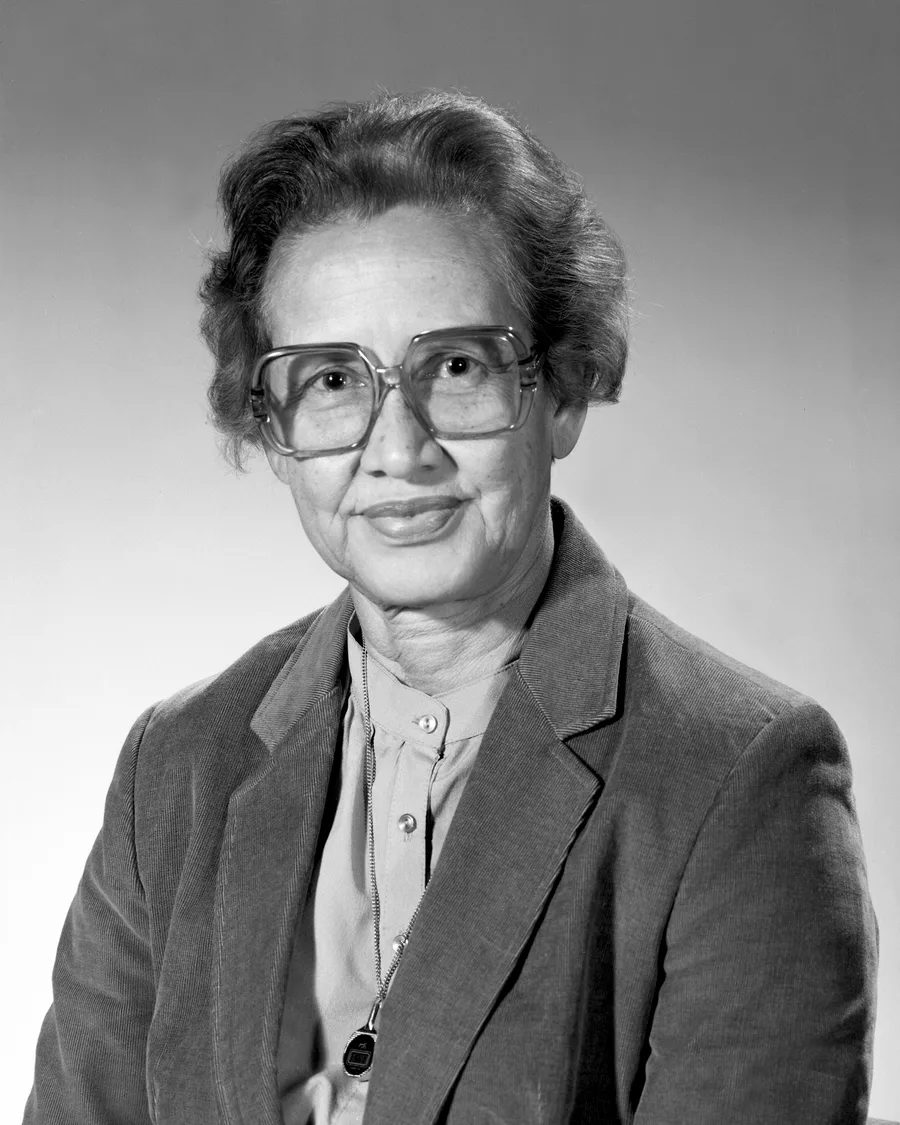
Katherine Johnson
1918-2020
A Black mathematician at NASA whose trajectory calculations supported major U.S. space missions and became a symbol of hidden contributions in STEM.
Katherine Johnson was a mathematician whose calculations supported important NASA missions. Her story became widely known through the broader recognition of the Black women mathematicians often described as the hidden figures of the U.S. space program.
Early path
Johnson showed strong mathematical ability from a young age. Her education and career developed in a society shaped by racial segregation, which limited opportunities for Black students and professionals.
Her story is important because it shows that exclusion does not mean absence. Many people from marginalized groups were present in STEM history, but their work was often ignored or under-recognized.
Turning point
Johnson joined what was then NACA, later NASA, as a mathematician. She worked on flight trajectories, orbital mechanics, and calculations that supported crewed space missions.
A famous part of her story is the trust astronauts placed in her calculations. Her work helped connect abstract mathematics to real human safety and exploration.
Work and impact
Johnson contributed to calculations for missions connected to Mercury and Apollo. Her legacy is now part of NASA history and STEM education because it reveals how much scientific progress depends on people whose names are not always visible at first.
Her story is especially useful for this project because it directly challenges the stereotype that STEM history was made only by one narrow group of people.
What readers should take away
Katherine Johnson’s path shows that representation is also about historical correction. Some role models were always there; society simply failed to tell their stories.
For students, her example shows that mathematical skill, precision, and persistence can have world-changing impact, even when recognition comes late.